

Global demand for EV batteries continues to grow strongly. By 2030, EV battery usage is expected to reach approximately 3 TWh, and by 2035, approximately 9 TWh. This represents more than a threefold increase compared to today's usage. The use of electric trucks is also expected to increase similarly. Electric trucks are projected to account for approximately 10% of total EV battery deployment in 2035, representing an 8% increase compared to 2025. Similarly, a twofold increase is expected in maritime transport by 2035.
Sodium-ion batteries, particularly LFP chemistries, perform significantly better than lithium-ion batteries at low temperatures. The latest generation of sodium-ion batteries can maintain approximately 90% of their nominal capacity at temperatures as low as -40°C and operate at temperatures up to 70°C. Recently, sodium-ion batteries are expected to be more suitable for small-range electric vehicles, light commercial vehicles operating in urban areas, two- and three-wheeled vehicles, industrial equipment such as forklifts, and battery stationary storage. They can also help reduce range loss in cold weather when used in hybrid EV battery packs combining lithium-ion and sodium chemistries. Solid-state batteries are attracting attention with their longer driving range and enhanced safety features and are striving for widespread use.
All these technical advancements and new technologies continue to accelerate the growth of EV battery adoption. Challenges in oil pipelines and production are seen as other factors supporting the acceleration of the EV battery sector's development.
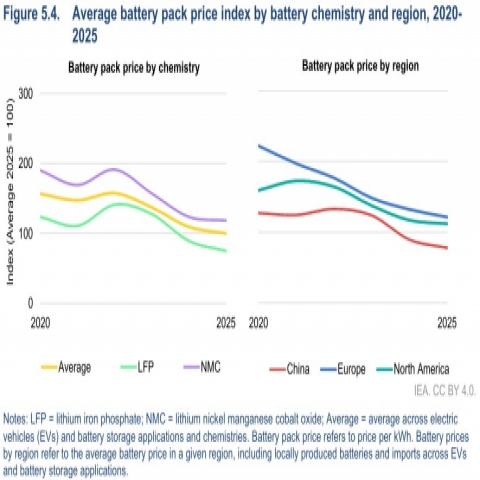
In the last few years, the average battery price has decreased across all regions, but regional price differences have widened. In 2025, battery pack prices in China were 30% lower than in North America and 35% lower than in Europe; in 2022, they were 20% and 25% lower, respectively.
- Log in to post comments